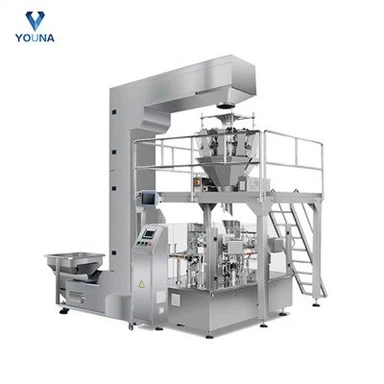

Six common problems in the production process of automatic packaging machines
Apr 21, 2026
Packaging machines are divided into vertical and horizontal types. Vertical machines are further divided into continuous (also called roller type) and intermittent (also called clasp type) types. Bags are produced using three-side sealing, four-side sealing, and back sealing methods, and there are also multi-row packaging machines. Packaging equipment is diverse, and the differences between different machines are significant. In the actual use of composite film rolls, various problems may be encountered. This article analyzes in detail the causes of six common problems for reference.

I. Positioning Marker Issues
In the automatic packaging process of composite film rolls, positioning heat sealing and positioning cutting are often required, necessitating the use of photoelectric positioning marks. The size of the marking mark varies depending on the packaging machine. Generally, the width of the marking mark should be greater than 2mm, and the length greater than 5mm. The marking mark is generally a dark color with a high contrast to the background color, such as black. Red and yellow cannot be used as marking marks, nor can the same color as the photoelectric sensor's light be used. For example, if the photoelectric sensor emits green light, a light green color cannot be used as the marking mark color, because a green photoelectric sensor cannot recognize green. If the background color is a dark color (such as black, dark blue, dark purple, etc.), the cursor should be designed as a light-colored cursor with a cutout showing white.
Generally, the photoelectric sensor system in automatic packaging machines is a simple recognition system and does not have the intelligent length-fixing function of a bag-making machine. Therefore, within the longitudinal range of the photoelectric sensor cursor, the roll film must not have any interfering text or patterns, otherwise it will cause recognition errors. Of course, some highly sensitive photoelectric sensors can precisely adjust their black-and-white balance, and some light-colored interference signals can be removed through adjustment, but interference signals from patterns with colors similar to or darker than the cursor cannot be removed.
The spacing between cursors is used for length determination, so the error between the actual spacing and the design value cannot be too large, generally only 0.5mm is allowed. For many automatic packaging equipment, negative deviation has a better tracking effect than positive deviation, so it is recommended to design it with negative deviation.
Aluminum-plated or pure aluminum has strong specular reflection, which will affect the recognition of the photoelectric sensor. It is recommended that the composite film cursor be printed with a white background. For transparent composite films, due to the influence of the color of the items they come into contact with, it is recommended to print the markings on a white background to reduce interference.
II. Friction Coefficient Issues
Friction during the packaging process often acts as both a dragging force and a resistance force, therefore its magnitude should be controlled within an appropriate range. For roll materials used in automatic packaging, a low inner layer friction coefficient and a suitable outer layer friction coefficient are generally required. An excessively high outer layer friction coefficient will cause excessive resistance during packaging, leading to material stretching and deformation. If it is too low, it may cause slippage in the drag mechanism, resulting in inaccurate photoelectric tracking and cutting positioning. However, the inner layer friction coefficient also cannot be too low. In some packaging machines, an excessively low inner layer friction coefficient can cause unstable stacking during bag forming, resulting in misaligned edges. For composite films used in strip packaging, an excessively low inner layer friction coefficient may also cause slippage of the tablets or capsules being fed, resulting in inaccurate feeding positioning. The inner layer friction coefficient of a composite film mainly depends on the content of the opening agent and slip agent in the inner layer material, as well as the film's stiffness and smoothness. The corona treatment process, curing temperature, and time during production also affect the product's friction coefficient. When studying the coefficient of friction, special attention should be paid to the significant impact of temperature. Therefore, it is essential to measure not only the coefficient of friction of the packaging material at room temperature but also at the actual operating temperature.
III. Heat Sealing Issues
Low-temperature heat-sealing performance is primarily determined by the properties of the heat-sealing layer resin, and is also related to pressure. Generally, higher extrusion temperatures during extrusion lamination, excessive corona treatment, or prolonged film storage will reduce the material's low-temperature heat-sealing performance. Hot tack describes the strength of the molten surface of the heat-sealing layer against external forces when it has not fully cooled and cured after heat sealing; such external forces often occur in automatic filling and packaging machines. Therefore, composite film rolls used in automatic packaging should be made of heat-sealing materials with good hot tack. Anti-contamination heat-sealing performance, also known as heat-sealing performance against contaminants, refers to the ability to heat-seal even when the heat-sealed surface is adhered to by contents or other contaminants. Different heat-sealing resins should be selected for composite films based on different packaged materials, different packaging machinery, and different packaging conditions (temperature, speed, etc.); a single heat-sealing layer cannot be used uniformly. For packaging with poor heat resistance, low-temperature heat-sealing materials should be selected. For heavy-duty packaging, heat-sealing materials with high heat-sealing strength, high mechanical strength, and good impact resistance should be selected. For high-speed packaging machines, heat-sealing materials with low-temperature heat sealing and high heat-adhesion strength should be selected. For products with strong pollution, such as powders and liquids, heat-sealing materials with good pollution resistance should be selected.
IV. Problems with Heat-Sealed Extruded PE
During the heat-sealing process of composite films, PE is often extruded and adheres to the heat-sealing film, accumulating and affecting normal production. Simultaneously, the extruded PE oxidizes on the heat-sealing die, emitting smoke and odor. The problems with heat-sealed extruded PE can generally be addressed to some extent by reducing the heat-sealing temperature and pressure, adjusting the heat-sealing layer formula, and modifying the heat-sealing film to reduce pressure at the edges. However, practical experience shows that the best solution is to use an extrusion lamination process to produce the composite film, or to increase the speed of the packaging machine so that the PE cannot be extruded onto the heat-sealing film in time.
V. Heat Seal Puncture and Breakage Issues
Puncture refers to the formation of a hole or crack through packaging material due to external pressure. Common causes include:
① Excessive heat sealing pressure. During the heat sealing process, excessive pressure or non-parallel heat sealing molds can cause localized excessive pressure, often puncturing fragile packaging materials.
② Rough heat sealing mold with sharp edges or foreign objects. Poorly manufactured new heat sealing molds often damage packaging materials. Some molds, after being damaged, develop sharp edges, which can easily puncture the packaging material.
③ Incorrect packaging material thickness. Some packaging machinery has requirements for packaging material thickness. If the thickness is too large, certain parts of the packaging bag may puncture. For example, in pillow-type packaging machines, the thickness of the packaging material should generally not exceed 60µm. If the packaging material is too thick, it is very easy to break at the center seal of the pillow-type packaging.
④ Incorrect packaging material structure. Some packaging materials have poor puncture resistance and cannot be used to package hard, angular objects.
⑤ Improper mold design. If the mold openings of the heat-sealing mold do not match the shape and size of the packaged goods, and the mechanical strength of the packaging material is not high, the packaging material is easily punctured or cracked during packaging.
VI. Heat-sealing leaks
Leaks occur because certain factors prevent the areas that should be sealed by heating from being properly sealed. Leaks generally have the following causes:
① Insufficient heat-sealing temperature. The required heat-sealing temperature varies for different parts of the same packaging material, different packaging speeds, and different ambient temperatures. The required heat-sealing temperatures for longitudinal and transverse sealing differ, and even within the same heat-sealing mold, different parts may have different temperatures. These are all issues that must be considered in packaging. For heat-sealing equipment, there is also the issue of temperature control accuracy. Currently, the temperature control accuracy of domestically produced packaging equipment is relatively poor, generally with a deviation of 10°C. This means that if the controlled temperature is 140°C, the actual temperature during packaging is between 130-150°C. Many companies use random sampling of finished products to check airtightness, but this is not a good method. The most reliable method is to sample at the lowest temperature point within the temperature range, and sampling should be continuous to ensure the sample sufficiently covers all parts of the mold, both longitudinally and transversely.
② Contamination of the sealing area. During the packaging filling process, the sealing area of the packaging material is often contaminated by the packaged goods. Contamination is generally divided into liquid contamination and dust contamination. This problem can be solved by improving packaging equipment and using anti-contamination and anti-static heat-sealing materials.
③ Equipment and operational issues. Such as foreign objects in the heat-sealing mold, insufficient heat-sealing pressure, or non-parallel heat-sealing molds.
④ Packaging material issues. Such as excessive corona treatment or too much slip agent in the heat-sealing layer causing poor heat sealing.